
Dictator aesthetic
Anne Stevenson-Yang

The DC beautification project of Lady Bird, Lyndon Johnson’s wife, involved lots and lots of flowers. Whenever my family drove up Rock Creek Parkway, we admired the daffodils she had planted along the Parkway’s slopes. There were the daffodils, tulips, and azaleas, cherry blossoms (more of them—the Japanese had donated more than 3,000 trees that grew where the Jefferson Memorial was later built), neighborhood parks, waterway cleanups, and much more. Lady Bird wanted to create ‘masses of color where the masses pass.’
Compare that to the Trump project of turning DC into what could pass for Liberace’s bedroom. There are the gold ornaments that Trump apparently sticks all over the White House with Super Glue, the proposed ballroom that looks like it was designed by a five-year-old girl in her Disney princess phase, the ‘National Garden of American Heroes,’ displaying 250 statues of marble and bronze, and the 47 maple trees he will plant in Lafayette Park to commemorate himself as the 47th president. Trees sound a little more tasteful than the Cheesecake Factory cursive labels on White House rooms, but then you learn that the maple is Trump’s favorite tree, so it’s more a Little Prince vibe—Trump making his own little garden.
The avatar of Trump’s dictator aesthetic is the planned ‘Arc de Trump.’ The design follows the French Arc de Triomphe but much bigger and with more gold; and while the Parisian arch has an observation deck on top for regular people to walk around, the Trump arch is to be topped by a set of gilded statues. The arch might be the only part of the Trump Administration that Divine, the drag queen star of Pink Flamingoes, would have loved.
Trump’s arch plan reminds me of Mao Zedong’s Monument to the People’s Heroes in Tiananmen Square. In Chinese cosmology, Beijing reflected the heavens. The emperor, at one end of the square behind Tiananmen Gate, occupied the center of the earthly realm. Tiananmen Gate (‘Heavenly Peace’) stands on the north-south axis to the city from Qianmen Gate (the Front Gate to the city), mirroring the axis around the North Celestial Pole, with the emperor as the North Star. Qianmen marked the entrance to the Imperial City from the outer capital and started a processional avenue to the Forbidden City, where the emperor lived. From Qianmen, Tiananmen Gate measures exactly 960 meters, a number that in Chinese numerology represents completeness and imperial authority. Mao erected the Monument to the People’s Heroes in the middle of Tiananmen Square, seizing the celestial sweep for himself, a way of proclaiming that he, too, was an emperor.
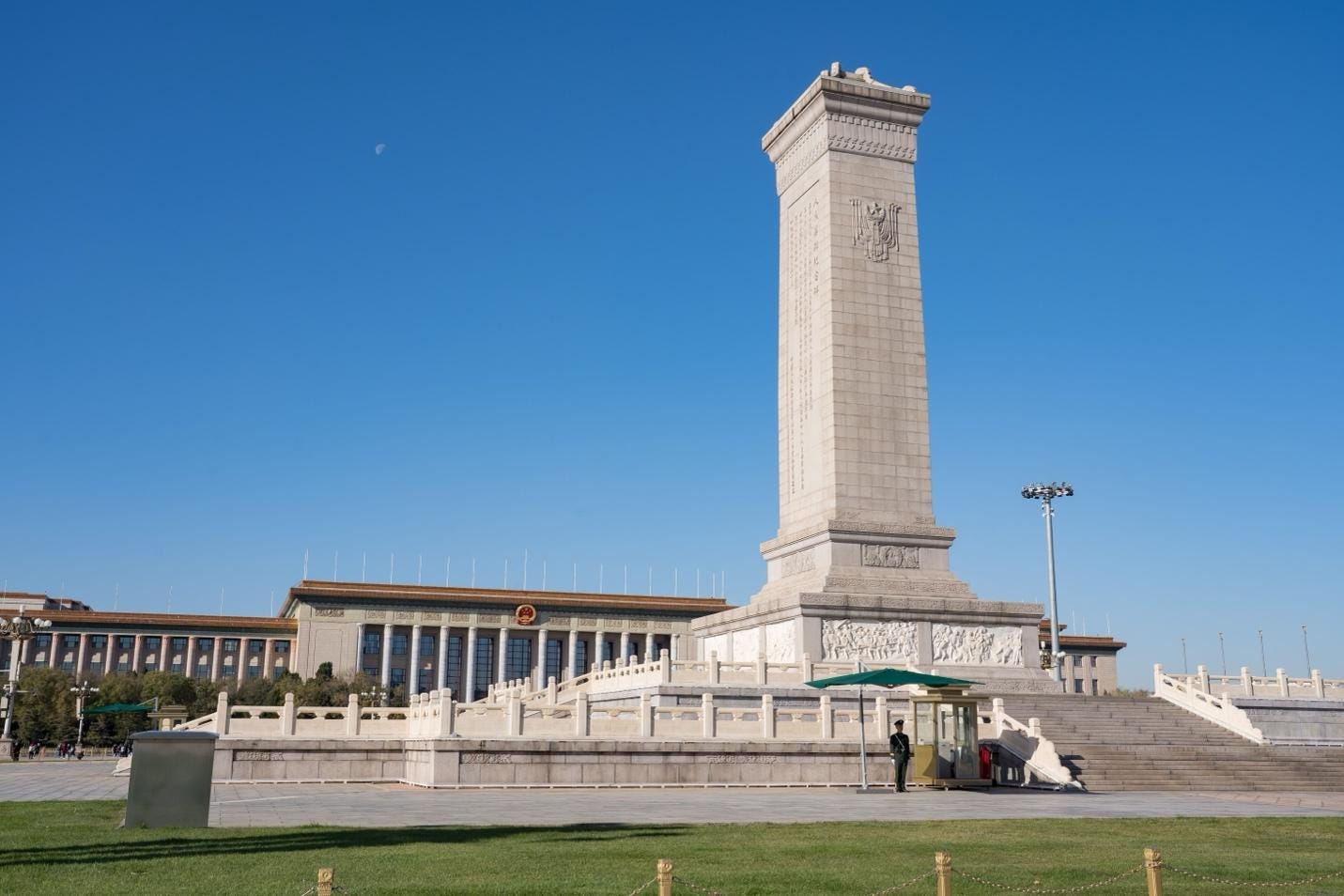
Mao was a cultured man who understood Beijing’s celestial design; usurping it for a Communist monument was certainly intentional. In the case of the ahistorical Trump, it is not clear who chose the site, but the proposed location of the arch between the Arlington Cemetery and the Lincoln Memorial does the same sort of violence to history. Arlington Cemetery was the personal estate of General Robert E Lee, who commanded the losing, pro-slavery side in the American Civil War. The US government seized the estate the day after Virginia voted to secede. Lincoln, whose statue sits in the memorial, of course freed the slaves. By inserting a monument to himself between the two, Trump, or the white supremacists around him, is intentionally denying the importance of the Union victory and, by association, freedom for Americans of African origin.
Many dictators of the past and present have erected monuments in order to mold history to their own conceptions. The men who have managed to get their monuments erected tend to lead totalitarian, broken countries that no one lives in by choice. A famous one is Saparmurat Niyazov, the former leader of Turkmenistan, who transformed his entire capital city into a personal monument, decorating his palaces with custom gold-plated fixtures and an ‘Arch of Neutrality,’ clad in white marble and gold plate. The arch bore a statue of Niyazov himself motorized and programmed to rotate so that his face was always directly bathed in the sun. Tellingly, Niyazov’s successor had the arch dismantled and moved.
In Pyongyang, 72-foot-tall bronze statues of the nation’s founder, Kim Il-sung, and his son, Kim Jong-il that were originally leafed in gold sit on Mansu Hill, a pilgrimage site for the state-mandated cult of personality surrounding the Kims.
“Trump’s monuments, existing and planned, represent a means of forcing history to bend to Trump’s will. “
Monuments to prominent Confederate rebels and slaveowners have been central to the MAGA movement. In 2017, for example, a vote in South Carolina to remove a statue of Robert E. Lee from a local park led to the ‘Unite the Right’ rally, a display of Nazi chanting and antisemitism praised by then-President Trump. It was a declaration that the white supremacist strain in American history was again triumphant. Trump’s monuments, existing and planned, have the same flavor: they represent an attempt to reshape historical memory.
Lady Bird, as a small-d democrat, was interested in general beautification. She focused on landscaping, environmental preservation, and public art galleries. Gerald Ford made the theme of the bicentennial national renewal, reconciliation and continuity rather than triumphalism. Fifty years later, America is not governed but ruled.
A mark of the dictator is a sense of not belonging among the reigning elites. It is often noted that Stalin was Georgian, Hitler Austrian, and that Trump, with his hair plugs and louche attitude, has always been viewed by the New York elite as a parvenu who must be tolerated but really doesn’t belong in your living room.
Kitsch hails straight from the era of cheap mass production and thus is fitting for the arriviste. The Industrial Revolution was the first time when gilt and statuary became easy to make and widely available. Almost universally, the 19th century is the era when aesthetics went to hell, and it is the era most beloved of the nouveau riche in America and China alike.
The dictator aesthetic also promotes sentimentalism. The posters and leader portraits of Maoist China and the Stalinist Soviet Union presented flamboyant displays of simplified emotion—young people lost in admiration for the leader, workers and soldiers bursting with pride. Trump has issued executive orders banning abstraction in art on the National Mall. That ‘socialist realist’ art is alien to the critical and distanced aesthetic that characterizes ‘high’ art in Western cultures.
That difference may be part of the attraction for Trump of all the gold eagles and marble statues. His kitschy dictator aesthetic feels like a thumb in the eye of the cultured.
Socialists and fascists alike deploy kitsch to flood public spaces not only with portraits of leader glory but with romanticized, sentimental images of a mythic past. Hitler tasked sculptors with building hyper-muscular bronze and granite statues of soldiers and athletes to decorate the Third Reich’s architectural projects. Mussolini created a sports complex in Rome with more than 60 huge statues of Carrara marble depicting nude male athletes. Trump has directed that figures selected for the National Garden emphasize a ‘traditional’ view of American history as strong, individualistic, and combative.
There is also the claiming of classical images. Plans for the Arc de Trump include gilded statues, including a mash-up of the Statue of Liberty and Nike, the Greek goddess of victory for whom the sports shoe was named, flanked on either side by golden eagles. China’s socialist-realist art featured murals of party leaders dandling apple-cheeked children on their knees. With the Trumpification plan, Washington is one step closer to Dear Leader art.
Anne Stevenson-Yang is the author of Wild Ride and Hello, Kitty, published by Bui Jones